

5 Signs Your Assisted Living Facility Needs an Operations Review
Assisted Living, Operations Review, Senior Living Operations Management
5 Signs Your Assisted Living Facility Needs an Operations Review
When an assisted living community runs on habit instead of clear systems, early warning signs can be easy to overlook. Callouts get covered at the last minute, families are a little more frustrated than they used to be, and bills seem higher even though occupancy has not changed much. On the surface, your building looks busy and your team is working hard. Underneath, your operations may be quietly drifting off course.
Maybe this sounds familiar: your caregivers are committed, but frequent callouts keep throwing the schedule off. Family complaints seem to be increasing. Assisted living occupancy isn’t where you expected it to be. Expenses keep creeping up, yet you feel like you’re constantly in “firefighting mode” instead of confidently leading your facility forward. The lights are on, residents are being served, but you’re spending most of your day reacting to problems instead of directing your team.
These issues are rarely random. They usually point to deeper gaps in staffing systems, communication routines, financial monitoring, and operational accountability. Your team is doing its best, but the way work is organized, supervised, and reviewed may not be supporting them the way it should. That’s where an assisted living operations review becomes essential.
An operations review is a structured evaluation of how effectively your facility’s processes, staffing, resident services, financial controls, assisted living quality assurance activities, and management systems are functioning. In simple terms, you take a step back and look at the inputs, workflows, and results across your building to understand what’s working, what isn’t, and where risks are quietly growing. The goal is not to assign blame; it’s to identify weaknesses, reduce operational risk, and build a realistic assisted living facility improvement plan you can actually implement over the next 30–90 days.
In this article, we’ll walk through five clear warning signs that your facility may need an assisted living operational audit or review, how to conduct that review step by step, and how to turn your findings into a 30-day assisted living operations improvement plan. Throughout, we will focus on practical actions you can take as an owner or administrator, even if you don’t have a large corporate team behind you.
Sign #1 — Staffing Problems Keep Disrupting Daily Operations
In senior living operations management, recurring staffing issues are one of the clearest signals that your underlying systems need attention. When your daily schedule feels fragile, it’s usually not just “a bad week.” It often reflects weaknesses in scheduling, onboarding, supervision, workforce planning, or backup coverage that are putting constant pressure on your team.
Frequent last-minute callouts and repeated scheduling gaps.
Excessive or increasing overtime that never seems to stabilize.
High employee turnover, especially among caregivers and med techs.
Inconsistent shift handovers and missed updates about resident needs.
Employees feeling overwhelmed, rushed, or unclear about priorities.
You, as the owner or administrator, frequently covering shifts or spending hours solving scheduling problems.
Operationally, this leads to burnout, inconsistent service delivery, higher labor costs, and potential risks to resident care. From a performance perspective, it often shows up as unpredictable staffing patterns and rising overtime in your assisted living performance indicators, even when occupancy is stable.

In an assisted living operations review, you would examine:
Staffing schedules and coverage patterns by day, shift, and role.
Overtime records and trends over the last 30–90 days.
Employee turnover trends and common exit reasons, where available.
Staff qualifications, training completion, and competency checks.
Onboarding procedures and how new staff are introduced to your routines and expectations.
Backup coverage plans and how often they are used in practice.
Shift handover processes and documentation of resident updates.
As a practical starting point, pull the last 60–90 days of schedules and time records. Using Excel, Google Sheets, or your existing timekeeping system, you can:
List each shift by date, time, and role, and highlight shifts where you had callouts or coverage problems.
Total overtime hours by employee and by week to see where pressure is highest.
Note which positions or shifts are hardest to staff (for example, weekend overnights or evening med passes).
Review recent resignations and exit reasons to see if there are patterns related to supervision, workload, or scheduling.
💡 Simple Staffing Tracker: Create one sheet with columns such as Date, Shift, Role, Scheduled Staff, Actual Staff, Callouts, Overtime Hours, and Notes. Review it weekly to identify recurring gaps and refine your backup coverage plan.
You do not need advanced technology to improve staffing stability. Focus on building a more structured schedule, clarifying backup coverage expectations, reinforcing training, and ensuring staffing decisions always maintain required coverage, appropriate qualifications, and resident care standards in line with your state’s assisted living compliance framework.
Sign #2 — Occupancy Is Declining or Admissions Are Inconsistent
In assisted living facility management, occupancy is one of your most visible performance indicators. When occupancy is low or admissions are unpredictable, it often points to challenges in marketing, lead management, admissions processes, referral relationships, or resident retention. It also directly affects assisted living profitability and your ability to invest in staffing and quality improvements.
Available beds remaining unoccupied for extended periods without a clear explanation.
Fewer qualified inquiries from families or referral partners.
Tours that don’t convert into move-ins, with no consistent follow-up process.
Leads receiving inconsistent or delayed responses when they reach out.
Weak or declining referral relationships with hospitals, case managers, or community partners.
Unexpected move-outs or short lengths of stay without clear patterns being reviewed.
Consider this hypothetical example for assisted living occupancy: you operate a 20-bed facility with 14 occupied beds. Your occupancy rate is:
Occupancy Rate = (Occupied Beds ÷ Total Available Beds) × 100
In this scenario, 14 ÷ 20 = 0.70, or a 70% occupancy rate. The owner can see that six beds are empty but may not have a reliable way to see where prospective residents are dropping out of the admissions process. During an assisted living operations review, you would examine:
Current occupancy by room or bed and how it has changed over the last several months.
Inquiries received, tours scheduled, tours completed, and admissions.
Move-outs and reasons for discharge or relocation, where documented.
Lead follow-up practices: who responds, how quickly, and with what information.
Referral source performance: which partners send inquiries that result in appropriate admissions.
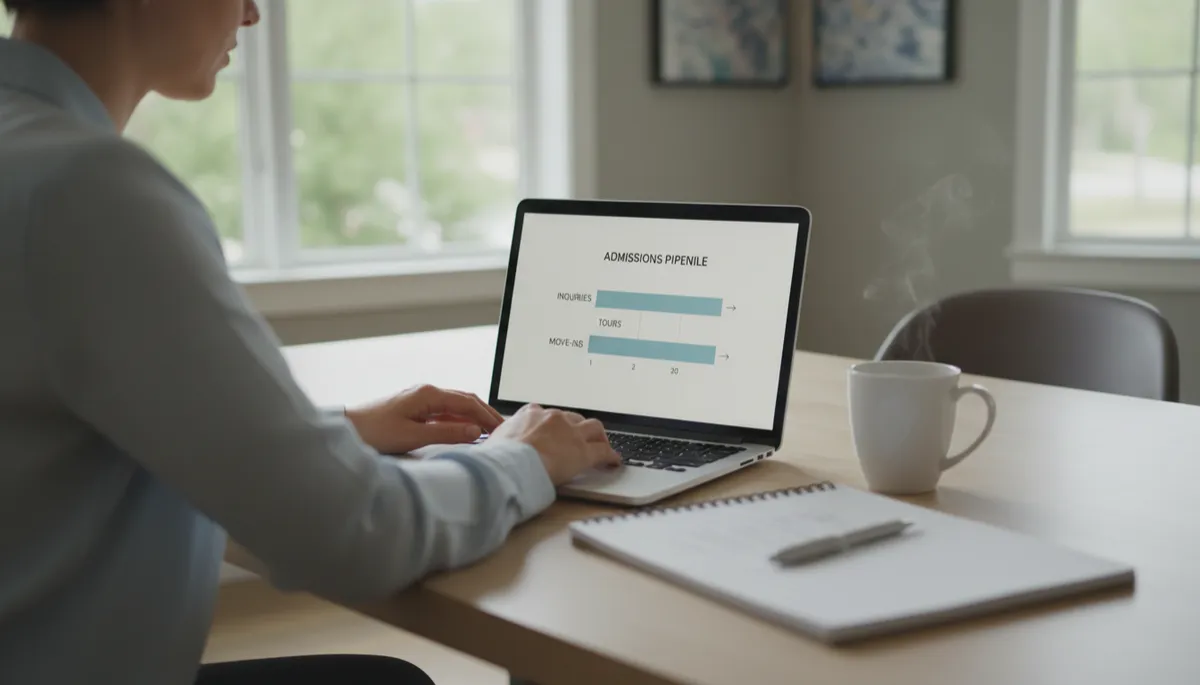
You don’t need complex software to start. A basic admissions tracker in a spreadsheet or simple tool can show your pipeline clearly. For example, create a table with columns such as:
Date of inquiry and lead name.
Referral source (hospital, case manager, online search, word of mouth, etc.).
General needs level (for example, low, moderate, high), based on your assessment process.
Tour scheduled (yes/no) and tour date.
Tour completed (yes/no) and outcome notes.
Admission decision (admitted, declined by family, not appropriate, waitlist).
Move-in date, move-out date (if applicable), and reason for move-out.
📌 Key Takeaway: Once you track these steps consistently, you can calculate simple ratios such as “inquiries to tours” and “tours to admissions.” This helps you see whether the main issue is attracting leads, converting tours, or retaining residents.
Use this information to review inquiry-to-admission conversion and strengthen appropriate referral relationships. Always ensure that admissions decisions are based on your facility’s ability and authorization to meet each prospective resident’s needs under your state’s assisted living compliance requirements.
Sign #3 — Resident and Family Complaints Are Becoming More Frequent
Complaints are a normal part of assisted living operations, but when you start hearing the same concerns repeatedly, it’s time to pay close attention. Repeated complaints often signal weaknesses in communication, care coordination, staff training, supervision, or accountability — all core elements of assisted living quality assurance and performance.
Families repeatedly asking for updates or feeling “out of the loop.”
Concerns being acknowledged verbally but not documented or tracked to resolution.
The same complaint appearing multiple times from different families or shifts.
Staff providing inconsistent information about routines, care plans, or follow-up steps.
Resident preferences not being communicated across shifts or departments.
Imagine this illustrative scenario: a family member reports a concern about their loved one’s daily routine. A staff member promises to “look into it” but doesn’t document the concern or assign it for follow-up. The issue doesn’t get resolved, and the family raises the same concern again the following week. Over time, their trust erodes, and your assisted living facility performance suffers in ways that may not show up immediately on a financial statement.

During an assisted living operational audit or review, you would look at:
Complaint and concern records (with resident privacy protected and only appropriately authorized access).
Communication procedures: who receives concerns and how they are routed.
Response and follow-up practices, including documentation of what was done and when.
Staff responsibilities for resolving and escalating issues.
How resident preferences and care changes are communicated across shifts.
💡 Simple Framework:Listen → Document → Assign → Resolve → Follow Up. Any complaint handling process you design should clearly support each of these steps.
Complaints involving suspected abuse, neglect, immediate danger, or other reportable incidents are different. Those require immediate protective action and any applicable reporting procedures under your state’s regulatory structure, not just a routine customer service workflow. Always protect resident privacy and communicate only with appropriately authorized parties.
Sign #4 — Operating Expenses Are Rising Without Clear Explanations
A facility can maintain reasonable occupancy and still feel constant financial pressure when expenses aren’t monitored and explained consistently. If your costs keep rising and you do not have a clear view of why, it becomes difficult to plan, invest, or respond to unexpected changes. For assisted living business growth, you need visibility into your cost drivers just as much as your revenue.
Increasing overtime costs without a clear staffing plan to address them.
Frequent emergency purchases instead of planned ordering and inventory management.
Supply waste or inconsistent tracking of food, cleaning, or care-related items.
Unexplained spending increases in certain categories from month to month.
No regular budget-versus-actual review as part of your assisted living operations routine.
One useful metric is the operating expense ratio:
Operating Expense Ratio = Operating Expenses ÷ Operating Revenue × 100
Here is a hypothetical example:
Operating revenue: $80,000 per month.
Operating expenses: $68,000 per month.
$68,000 ÷ $80,000 = 0.85, or an 85% operating expense ratio. The remaining $12,000 is a simplified operating surplus before any costs excluded from the calculation. It is not necessarily net profit, but it gives you a directional view of how much room you have to absorb unexpected expenses or invest in improvements.

During an assisted living operations review, examine:
Staffing expenses, including regular wages, overtime, and use of agency staff if applicable.
Food, supplies, utilities, maintenance, insurance, and administrative costs by category.
Purchasing procedures and who can approve which types of expenses.
Monthly financial reporting practices and how often leadership reviews them.
Review at least three months of comparable financial records. Identify your top cost categories and ask: which costs are required to maintain safe, high-quality care, and which might include avoidable inefficiencies? Any cost reduction plan must never compromise resident safety, required staffing, nutrition, maintenance, or quality of care. The goal is assisted living operational efficiency, not short-term cuts that create long-term risk.
Sign #5 — The Facility Depends Too Heavily on the Owner
Many assisted living communities start with an owner who does everything: marketing, scheduling, family calls, ordering supplies, even covering shifts. That’s normal in the early stages. But if your facility still depends on you for almost every decision, it’s a sign that your systems, delegation, and accountability structures haven’t kept up with your growth. When the facility cannot function smoothly without you on site, everyday tasks turn into risks.
Employees contacting you for routine decisions that could be handled by supervisors.
You approving every small purchase or schedule adjustment personally.
Tasks stalling when you are off-site or unavailable, even for a day or two.
Important processes existing only in your memory instead of written procedures.
This usually indicates weak operational systems rather than just a “busy schedule.” The antidote is building clear, practical standard operating procedures (SOPs). Effective SOPs should specify:
What needs to be done.
Who is responsible for each step.
When the task should happen and how often.
How the task should be completed at a basic, practical level.
Escalation: when and how to involve you or another leader.
Action Step: Identify three recurring tasks that always seem to land on your desk — for example, ordering supplies, responding to non-urgent family questions, or approving schedule swaps. Document each process in one page or less and delegate suitable responsibilities to qualified team members, while preserving required supervision, professional qualifications, safety standards, and regulatory accountability.
How to Conduct an Assisted Living Operations Review
Step 1: Gather Your Facility’s Performance Information
Start by collecting the information you already have. For most facilities, that includes staffing records, occupancy reports, admissions activity, financial reports, quality assurance findings, and complaint trends. Use de-identified information where appropriate and ensure only authorized individuals access resident-related data. Even a basic “data folder” — physical or digital — can be powerful when everything is in one place.
Step 2: Identify Your Biggest Operational Gaps
Compare current practices with your facility policies, applicable requirements in your state, and your own internal performance goals. Look for patterns: repeated staffing shortages on certain shifts, recurring complaints about the same issue, consistent delays in admissions follow-up, or categories of expenses that are rising faster than expected. You are looking for issues that happen again and again, not one-time events.
Step 3: Prioritize the Most Important Problems
Not every issue has the same urgency. Prioritize based on:
Resident safety and wellbeing.
Regulatory urgency and assisted living compliance considerations.
Operational impact on staffing, occupancy, or resident experience.
Financial consequences and assisted living facility performance.
Any urgent safety or mandatory corrective actions should be handled immediately and in line with your state’s requirements; they should not wait for the rest of your review to finish.
Step 4: Assign Corrective Actions
For each priority issue, document:
The specific action required (for example, “standardize shift handover checklist”).
The person responsible and any support they need.
The deadline or target date for completion.
How you will verify that the action was completed and is working.
Step 5: Monitor Progress and Review Results
Schedule short, regular follow-ups (weekly is often effective) to review progress. Are staffing gaps decreasing? Are complaints being closed with documented follow-up? Is your assisted living occupancy stabilizing or improving? Use a simple framework: Assess → Identify → Prioritize → Act → Monitor. Over time, this becomes part of your normal assisted living operations, not just a one-time project.
Your 30-Day Assisted Living Operations Improvement Plan
Week 1: Review Your Current Performance
Gather your key information: schedules, overtime, occupancy, admissions activity, operating expenses, complaints, and any internal quality assurance notes. Don’t worry about perfection; focus on getting a clear snapshot of where you are today so you can start building a realistic assisted living facility improvement plan.
Week 2: Identify and Prioritize Problems
Look for the five warning signs we’ve discussed: staffing instability, declining or inconsistent occupancy, increasing complaints, rising expenses, and heavy dependence on you as the owner. Decide which issues require immediate action and which can be addressed through structured improvements over the next few months.
Week 3: Implement Corrective Actions
Assign responsibilities, update or create simple procedures, provide any necessary training, and establish deadlines. For example, you might roll out a new shift handover checklist, standardize how admissions leads are tracked, or set a recurring monthly budget review meeting. Keep the changes practical and focused on your most important assisted living management challenges.
Week 4: Measure Progress
Review what has changed. Are staffing callouts more manageable? Are complaints being tracked and closed? Do you have a clearer view of your admissions pipeline and operating expenses? Use what you learn to decide your next round of improvements. A 30-day review is a starting point for ongoing quality improvement, not a replacement for required inspections, reporting, or regulatory processes in your state.
Don’t Wait Until Small Problems Become Bigger Challenges
Assisted living operations are complex, but the early warning signs are usually visible if you know where to look. Five of the most important signals are:
Recurring staffing problems and assisted living staffing challenges that disrupt daily operations.
Declining or inconsistent occupancy and unclear admissions pipelines.
Increasing resident and family complaints without clear follow-up.
Rising or unexplained operating expenses that strain assisted living profitability.
Excessive dependence on you as the owner or administrator for routine decisions.
A well-structured assisted living operations review helps you step back from daily firefighting and see the full picture. It connects staffing, occupancy, finances, resident experience, and compliance into one coherent view, so you can make informed decisions about where to focus your time and resources. Over time, this kind of consistent, data-informed approach supports assisted living business growth, operational stability, and a better experience for residents, families, and staff.
A high-performing assisted living facility isn’t one that never experiences problems. It’s one that has the systems to recognize problems early, respond appropriately, and keep improving.
Take Your Next Step with Assisted Living Network Group (ALNG)
Assisted Living Network Group (ALNG) focuses on giving assisted living owners and operators the practical tools they need to build stronger systems, not just work harder. If you’re ready to go deeper into assisted living facility management, consider exploring Assisted Living 103: Running a High-Performing Facility — Advanced Operations, Profitability & Growth. This educational course covers operational performance, staffing systems, occupancy, financial management, quality assurance, resident experience, and practical facility improvement planning in more detail.
If you recognize any of these warning signs in your facility, begin with a structured operations review. Identify your most pressing challenges, establish corrective actions, and take practical steps toward stronger operations and more consistent resident care.
